ONE GAME REPLACEMENTS
The Story of the 1912 Detroit Tigers Replacement Team

This article was written by Dylan James
It’s Detroit, Michigan—May of 1912. The city skyline is on the rise as the automotive industry expands at breakneck speed. There is hope and hard work. The blue-collar workforce of natives and immigrants work grueling factory hours. Their silver lining? The Detroit Tigers.
A month earlier in April, the Detroit Tigers unveiled their brand new stadium in Navin Field (later known as Tiger Stadium). Their prior stadium in Bennett Park was a prehistoric, wooden construction; outdated and a perpetual safety hazard. There’s a new temple now. A place to worship Ty Cobb, George Mullin, and Sam Crawford. Mostly Cobb.

The mythical Cobb (Omaha Daily News, May 18, 1912)
After batting .419 in 1911 (his first occasion of three), Cobb is off to his usual hot start as the 1912 season begins. On May 15, in a game versus the New York Highlanders at Hilltop Park, Cobb takes an onslaught of insults from heckling fans. One fan in particular is vicious. In the away dugout, outfielder Sam Crawford listens to the crude remarks before turning to his teammate Cobb and asking, “Are you going to take that?” Cobb realizes that he, in fact, is not going to take that. He leaps over a railing and bullies his way up the stands, pushing his way through a hostile crowd before finding his intended target. Cobb batters the man with a barrage of punches, knocks him down, and uses his spikes to kick the man once his back is flat on the pavement.
Claude Lucker had lost one hand and a few fingers on his other during a freak printing-press accident a year prior. He’s the downed man, who Cobb doesn’t realize is disabled. Cobb doesn’t hear the fans shouting that Lucker has no hands, either. He just hears Lucker’s remarks on repeat in his head: “Your mother is a whore!” and other nasty slurs. Nearby and watching the scene unfold, American League President Ban Johnson doesn’t believe what he’s witnessing.
Long story short, Cobb is suspended indefinitely.

A contentious relationship begins (The Bridgeport Times, May 21, 1912)
The game’s premier player and unruly poster boy is…just gone? With the exception of consistent force Tris Speaker and an emerging talent gearing up for Cleveland named Joe Jackson, there is no hitter in Major League Baseball who comes close to Cobb’s offensive output. A man in a league of his own is suddenly (and actually) out of the league.
For the Tigers’ next game against the Philadelphia Athletics on May 17, Paddy Baumann replaces Cobb in center field. The Tigers win Cobbless at 6-3 but the story doesn’t end there. After the game, Cobb’s teammates (even the ones who butt heads with the great and touchy man) send a telegram to President Johnson: they are not taking the field again until Cobb is reinstated. Enraged, Johnson threatens to fine the team $5,000 for every game they do not play.
Word spreads around Detroit and the baseball world that in some great fluke of the universe, the Detroit Tigers do not have a baseball team. Frank Navin, Tigers’ owner, finds himself in a predicament; he understands the importance of Cobb’s presence and his teammates rallying behind him, but the sharp owner also recognizes that forfeitures could cost his Detroit club a lot of cash…and even their team. He devises a plan.
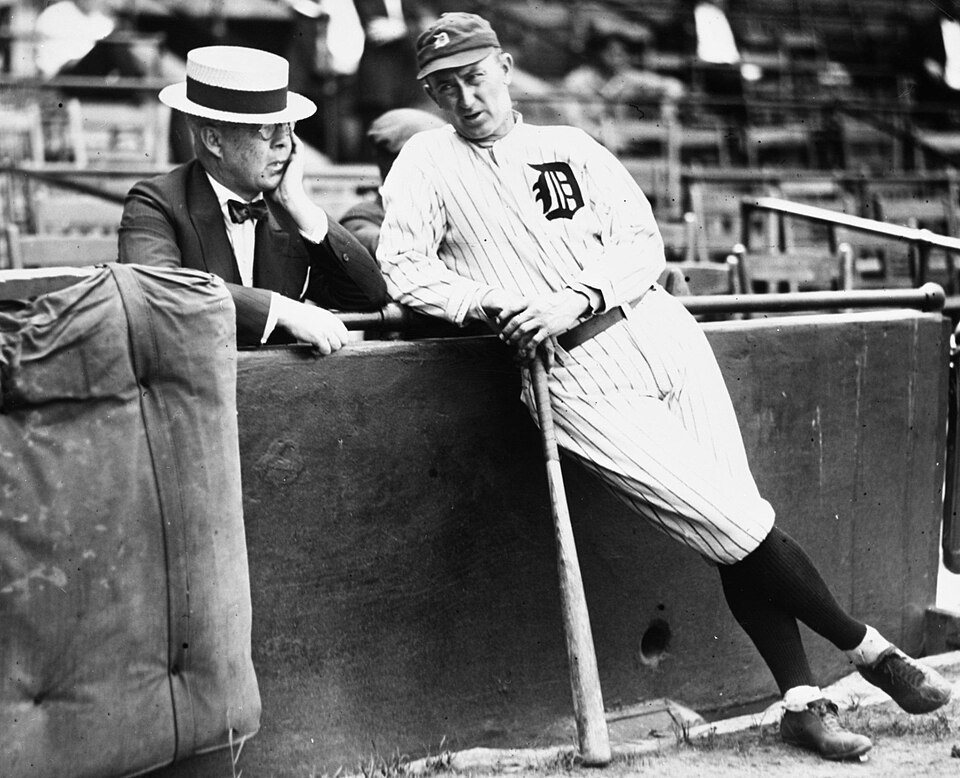
Frank Navin speaking to Cobb pregame circa 1921 (Public Domain)
Navin tells his manager Hughie Jennings to field a replacement team. Any means necessary. In the away city of Philadelphia, as game time approaches against the Athletics on May 18, Jennings and his coaches hit the Philly streets on the hunt for players. Sportswriter Joe Nolan of the Philadelphia Bulletin helps the desperate coaching staff out, knowing the area’s available talent better than most. Philadelphia Athletics manager Connie Mack also points Jennings in the direction of potential recruits.
Two amateur boxers are recruited to play for the Tigers—Billy Maharg and Bill Leinhouser. Found on a city street corner, 20-year-old Allan Travers is added to the roster as an outfielder (and is later the starting pitcher). Jennings is unaware that the lying Travers has never pitched a game in his life and was cut from making his high school’s varsity baseball team. Joe Nolan tells Travers to gather up some other ballplayers around the neighborhood, as Travers is the assistant baseball manager for St. Joseph’s College and knows a lot of sandlot and collegiate players in the area. Travers obliges, rounding up players while Jennings strikes out with recruiting a solid group of ballplayers from Pennsylvania University.
Talent is thin. So much so that Jennings and two other Tigers coaches in Joe Sugden and Deacon McGuire come out of retirement to help fill out the roster. McGuire returns to his usual digs at catcher and Sugden preps to play first base. Sugden, 41, last played in 1905 with noted offensive woes. McGuire’s last full season came in 1906, batting .299 for the Yankees. Jennings hasn’t seen a full season since 1902 and is 49-years-old. He won’t start but plans to pinch-hit.
Some semi-pro baseball players are found. Notably Ed Erwin, a journeyman minor-league catcher. In 1909, Erwin batted .232 in 54 appearances for the Raleigh Red Birds of the Class D Eastern Carolina League. His 1910 season was spent in the Class D Ohio State League.

Ed Irwin, 1909 Red Birds team picture (Public Domain)
Following a poor minor-league season in 1911, Irwin responded to an unusual advertisement in the Philadelphia Press: “Wanted—A catcher. Manager Red Dooin would like one or two husky backstops to report to the Phillies’ clubhouse to assist in warming up the large squad of pitchers.” Irwin landed the job and warmed up the Philadelphia pitching staff for a short duration, even making an exhibition appearance for the Phillies on April 21, where he went 1-4 with a double while catching a full nine innings in a 5-1 Phillies victory. Inevitably, in early May of 1912, the Phillies parted ways with Irwin. Jennings—in his hunt for replacement players—catches word of Irwin as “a player recently released by the Phillies.” Thinking his dream of making the Major Leagues has come to an end, Irwin miraculously finds himself in the Bigs.
Somehow Jennings and his coaches scrape together a team; a motley crew of 12 men featuring amateurs, semi-pros, and coaches returning to their former professional glory. The group is rounded out by chauffeur Dan McGarvey, factory machinist Jim McGarr, 18-year-old John Coffey (playing under the alias of “Jack Smith” given troubles with the law), salesman Joseph “Hap” Ward, and long-time minor leaguer Patrick Meaney (who could also be Edward Vincent Maney, another individual altogether—this mystery persists).
With the ragtag team assembled, Jennings instructs his replacements to arrive at Shibe Park early before the game and sit in the bleachers, which they do.
*************************
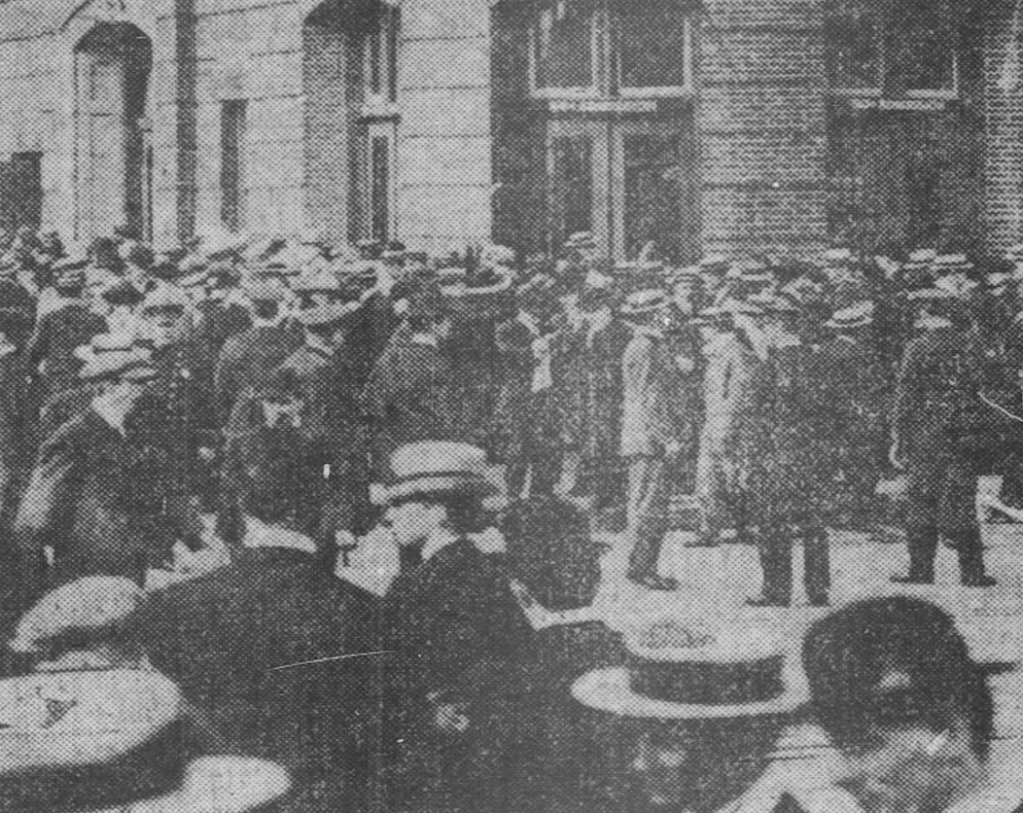
The crowd outside of Shibe Park on game day (The Philadelphia Inquirer, May 19, 1912)
On a warm and seemingly perfect afternoon for baseball, 15,000 fans fill up Shibe Park. Umpire Bill Dinneen shouts “Play Ball!” at 2:30 pm and fans gasp as Ty Cobb takes the field. The Tigers’ regulars take the field too, until ump Ed “Bull” Perrine waves Cobb out of center field. Cobb trots off the field as do the rest of his teammates. They head to the visitors’ clubhouse, take off their uniforms, and vanish. The game is in jeopardy of not being played. Or so it seems.
Coach Hughie Jennings rushes out of the dugout and signals his replacement team onto the field. Fans at Shibe don’t know what’s happening. The “new” Tigers make their way into the visitor’s clubhouse and promptly put on the uniforms of the AWOL Tigers’ players. Tasked with the job of playing center field in place of Ty Cobb, Bill Leinhauser puts on Cobb’s uniform and grabs Cobb’s glove to use in play. Leinhauser, an amateur welterweight boxer, knows he’s out of his depth (his wife reportedly hits him with a skillet later when she finds out he had the audacity to replace the Georgia Peach).
Jennings is ready to return to battle on the diamond, as are Sugden and McGuire. The three coaches understand that somehow, against all odds, the replacement team is actually going to play baseball today, and that this very well may be the worst team ever assembled on a Major League field. Knowing defeat is inevitable, the team heads to the dugout to await its turn to hit in the top of the first inning.
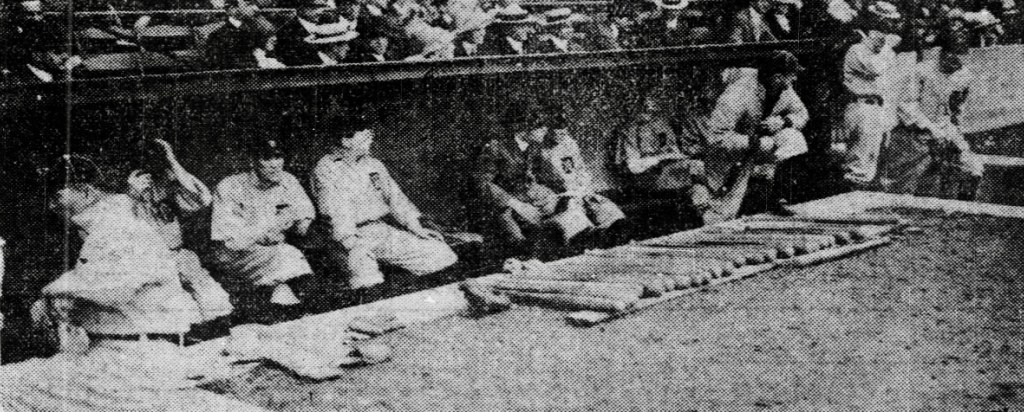
Anxiety palpable in the Tigers’ dugout (The Philadelphia Inquirer, May 19, 1912)
Licking their chops at the sight of fresh meat, the reigning back-to-back World Series champion Athletics take the field. Their skipper Connie Mack is not holding back his punches. Veteran ace Jack Coombs stalks out to the mound. Most of the Athletics regulars are in the lineup, featuring Eddie Collins, John McInnis, Jack Barry, and “Home Run” Baker.
The game begins. Coombs makes quick work of Detroit in the first. McGarr strikes out. Maharg grounds out to Short. Pitcher Allan Travers flies out to right. The fans are amused by the spectacle, and surprisingly, they aren’t checking out just yet.

Tigers’ regulars watching from the stands (The Philadelphia Inquirer, May 19, 1912)
The replacement Tigers appear on the field in the bottom of the first. Watching from the upper pavilion after buying tickets, the regular Tigers can’t believe what they’re witnessing. Donie Bush (Cobb’s teammate at shortstop) says, “It’s a circus. Gosh, I’m glad I came.” Second baseman Jim Delahanty (one of the leading instigators of the strike) reflects that sentiment: “This is great. I wouldn’t have missed it for a minute.”
Travers takes the mound and throws warm-up pitches to 48-year-old catcher McGuire. Jennings has instructed Travers not to throw fastballs. Off-speed only, specifically his very slow curve. Jim McGarr is at second—Billy Maharg is at third—Sugden is at first—Patrick Meaney patrols shortstop. McGarvey, Leinhauser, and Ward comprise the outfield. In the dugout, Ed Irwin and John Coffey are on the bench. This is really happening.
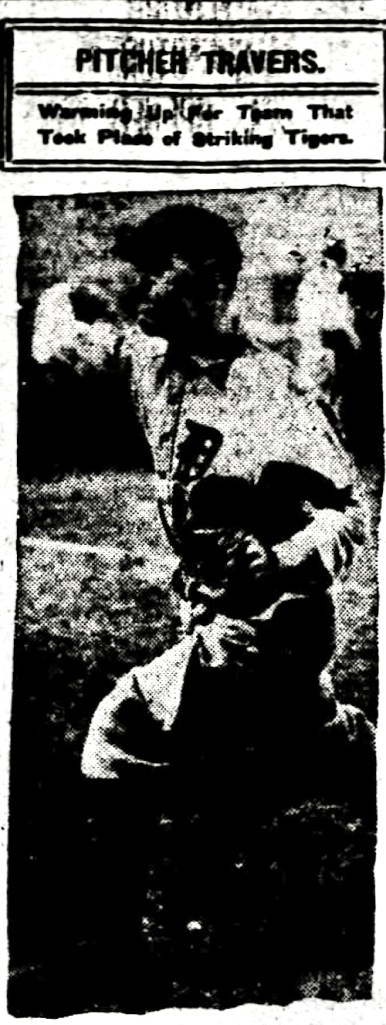

Ripe with nerves, Travers walks leadoff hitter Harl Maggert. With a runner on first base right out of the gate, Connie Mack employs a mischievous strategy. The next hitter Amos Strunk bunts to third base. Tigers’ third basemen Billy Maharg has never played the position (or organized baseball of any kind) and he doesn’t know how to field the bunt. Strunk reaches on a bunt single, as does the next Athletics’ hitter in Eddie Collins who also bunts to Maharg.
“I was doing fine until they started bunting,” Travers will recall years later. “The guy playing third base had never played baseball before. I threw a beautiful slow ball and the A’s were just hitting easy flies…trouble was, no one could catch them.”
Center fielder Bill Leinhauser struggles repeatedly to field his position and never forgets it. “I was chasing hits all over the outfield. Jennings finally came out and told me to forget about trying to catch them. ‘Just let the ball go and play it off the wall.’”
“Poor old Joe Sugden and Deacon Jim McGuire were there, of course,” The Pittsburgh Press observes. “They hobbled around and grinned cheerfully as they mumbled of the days that used to be.”
In the top of the third, right fielder Hap Ward does his finest impression of Sam Crawford, making a leaping catch in deep right-center to rob Athletics’ shortstop Jack Barry of guaranteed extra bases. Upon realizing the ball is in his mitt, Ward smiles from ear to ear. Nobody at Shibe is more excited than he is. Ward is a popular sandlot player in the New Jersey and Philly area, and here he is on the big stage. Wait ‘til he can tell his fellow salesman at Duo Fold Inc (an undergarment company) about this moment.
By the bottom of the third, the Tigers’ sloppy baseball has the Athletics ahead 6-0. An estimated 2,500-plus fans return to the box office and demand a refund. Whatever this is, it isn’t America’s pastime. The irate fans are informed that no refunds will be given, but they can take a rain check for a future game if they choose to. Most of the fans return to their seats in defeat. The game isn’t as bad as what people thought it would be, remaining respectably within reach at 6-0, but these Tigers are the “paper-tigers”—not Cobb and co.
On the upside, in the bottom of the third, Billy Maharg is benched after two innings of awkward play. Coach Jennings tells Ed Irwin to take the field at third base. In the top of the fourth, Irwin steps up to the plate with one out. The hitless Tigers have only been on base once thanks to a Hap Ward walk in the third. Facing Carroll “Boardwalk” Brown who has been freshly substituted for Coombs, Irwin smacks a triple to right field. It’s a beautiful moment. From minor-leaguer to released bullpen catcher to big-leaguer for a day, Irwin writes his name in the history books. Fans watching know nothing of this story nor do they care.
The Athletics are contained within the yard but the ball is flying around the field like a pin-ball. The game gets out of hand. The Athletics lead 14-0 after the fourth. In the top of the fifth, Tiger coaches Joe Sugden and Deacon McGuire muster back to back singles. Brown plumps Patrick Meaney next to the load the bases. When Athletics’ catcher Jack Lapp attempts to pick off Meaney at first base during Hap Ward’s at bat, the throw misses Stiff McInnis and rolls into the outfield, allowing Sugden and McGuire to score. The shutout is no more. The replacement team has done the impossible: scored. 14-2.

Patrick Meaney, 1908 Charleston Sea Gulls team picture (Public Domain)
Meaney stands on third base, watching Ward and McGarr strike out to end the top half of the fifth. A long-time minor leaguer (1892 to 1909), Meaney is an underdog with a story of his own. He began his minor-league career as a dazzling left-handed pitcher, heralded nationwide as a pitching prospect on the rise—and a sure thing to make the Bigs. After losing his ability to pitch thanks to a “dead” arm, Meaney learned to throw with his right arm and moved to the outfield. He’d always been an impressive hitter (as well as a friend of Joe Sugden from their time playing minor league ball together). Here at Shibe, Meaney is making his Major League debut at the age of 40—or so it is believed. Some baseball historians will later argue that Edward Vincent Meaney is actually Patrick Meaney, and there is evidence to support the claim. Bill Leinhauser himself, however, will identify Patrick Meaney as his former teammate in the 1950s. The truth remains uncertain—and it makes for a remarkable story regardless of which man it is.
On the bench for the Tigers, 18-year-old John Coffey has told everyone his name is Jack Smith. He is likely an escaped convict, having been arrested for larceny and receiving stolen goods. He had been given a sentence of three years at the Pennsylvania Industrial Reformatory in Huntingdon, yet here he is two months into that very sentence playing for the Detroit Tigers. Unexpectedly, Coffey is put into the game in the bottom of the seventh inning to play third base, while Ed Irwin is moved to his natural home behind the plate. Coffey plays a solid defense at third, recording three chances with two putouts, one assist, and a double play. No errors.
The Athletics compile runs, taking advantage of the inexperienced Tigers defense and pitching as the score balloons to 24-2 after the eighth. The defending champs record 26 hits (no homers) and steal 10 bags. Eddie Collins wreaks havoc on the basepaths and swipes 5 bags alone. The Tigers have made 7 errors. It’s bad, but for a replacement team, it’s not too bad, is it?
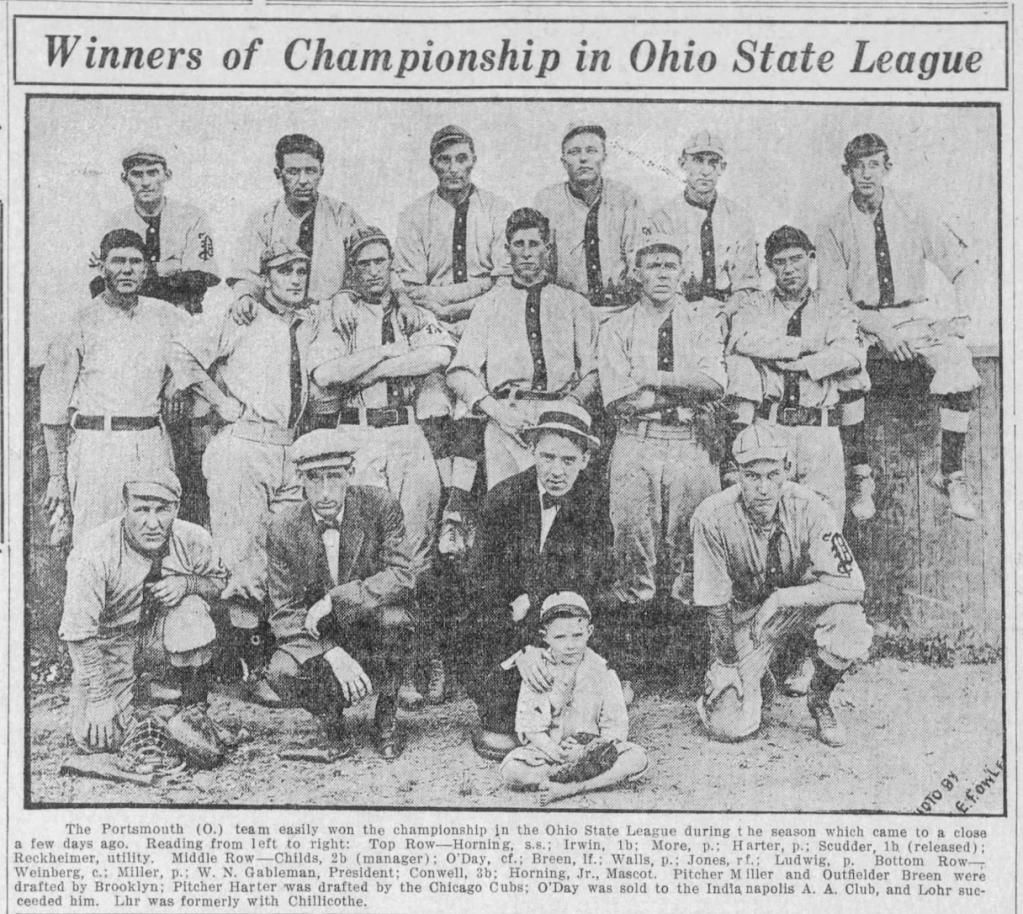
Ed Irwin, 1910 Portsmouth Cobblers team picture (The Cincinnati Post, September 23, 1910)
In the top of the ninth, Ed Irwin steps up to the plate to lead off the inning. Facing future Hall-of-Famer Herb Pennock and his masterful curveball, Irwin smacks his second triple of the game. Irwin is 2-3 with 2 triples and sets a Major League record that still stands: most triples without any other hits. His two hits make for half of the team’s total hits on the day. With Irwin in scoring position on third, Hughie Jennings pinch-hits for Allan Travers and strikes out. As do Leinhauser and Sugden. With that the game ends.
“I put a team on the field today to save the owners of the Detroit franchise from being fined $5,000,” Jennings relays to the press after the game. “It is now up to President Johnson of the league and President Navin of the Detroit club to settle with the ‘strikers’. I do not intend to take sides one way or the other. You can say this much for me. There will be a club, professional club of some sort on the field at Shibe Park on Monday.”
Appalled by the replacement game, American League President Johnson declares that no Detroit Tigers game will be played until the regular team is back on the field. As a result Detroit produces no team for their May 20 matchup against the Athletics. Johnson goes tit for tat, fining each Tiger regular $100 for missing the game—plus $50 for missing the replacement game.
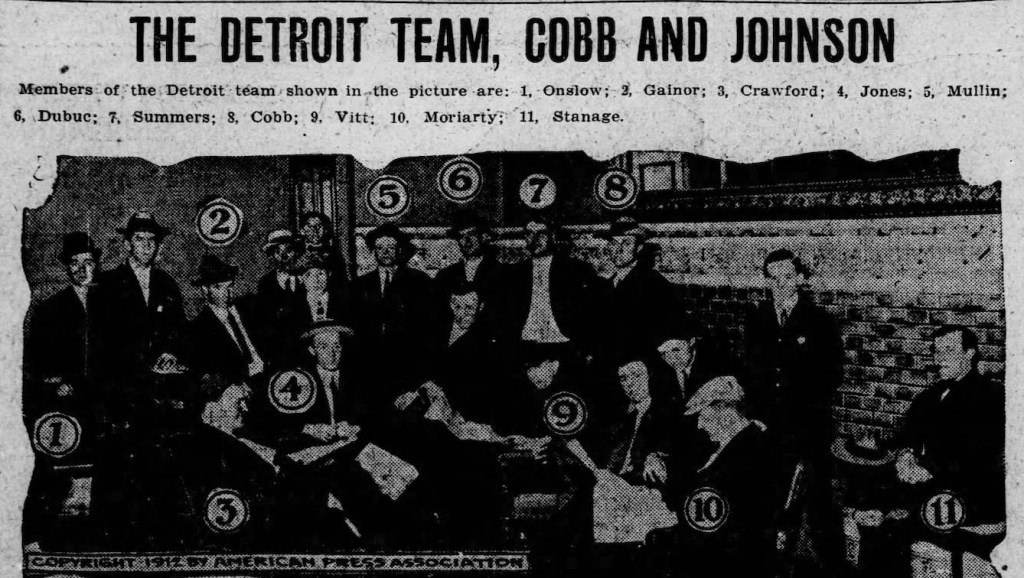
Tigers’ regulars ponder their next move (The Bridgeport Times, May 21, 1912)
Fines mount and pressure builds in the Tigers’ clubhouse. Navin urgently pleads with his players to return to the field, knowing he can’t keep an angry Ban Johnson at bay forever. Recognizing the situation, Cobb steps forward and tells his teammates he appreciates their loyalty but refuses to let them sink with him. Missing games and paying fines simply isn’t worth it. This is his fight, not theirs.
Cobb’s blessing to move forward without him allows Navin to reach an agreement with the team. At last, the regular Tigers take the field on May 21 to face the Washington Senators without Cobb, bringing the strike to an end.
On May 21, the reformed Tigers beat the Senators 2-0 in an epic pitching duel between George Mullin and future Hall of Famer Walter Johnson.
Four days later, Ban Johnson lifts Cobb’s suspension and fines him $50 for his behavior.
Holding their own in more ways than one, the replacement Tigers receive no praise despite competing against the repeat defending Champion Athletics. Travers is paid $25 for his day of service on the mound while the rest of the replacement gang is paid $10. The higher amount given to the starting pitcher is the sole reason why Travers opted to pitch.
In the end, receiving praise doesn’t matter. The “paper-tigers” played a game of Major League Baseball as underdogs unrooted for by the masses. Men who had no right on the baseball field—and others who were given a shot after years of fighting for it—made their mark in baseball history.
They belong to the ages.
*************************

1916 view of Philly from the Bell Telephone Building (Free Library of Philadelphia)
February 5, 1916 – It’s a dreary, cold evening. Ed Irwin attends a funeral. Afterwards, he heads to a local Philly bar he frequents called McCool’s Saloon. Accompanying him is William Fitzmyer. The friends sit by a front bulk window, where the unthinkable happens. Irwin and Fitzmyer get into a fight. Words lead to blows and the men find themselves grappling each other. Before the scuffle can be broken up by alarmed patrons, Fitzmyer lunges at Irwin and catapults him through the glass window.
A jagged shard slashes open Irwin’s jugular vein. Blood gushes from his neck. Saloon patrons urgently try to stop the blood loss. The ambulance arrives on the scene right as Irwin goes into shock. While in route to Women’s Homeopathic Hospital, Irwin succumbs to his injury in the ambulance.
Ed’s brother Benjamin Irwin asserts, “My brother slipped and fell back, striking his head against the glass. Fitzmyer did not throw him against the window nor did he touch him when the accident occurred.” The incident is a freak accident in Benjamin Irwin’s eyes, and that’s enough for Police Magistrate Beaton to release Fitzmyer from custody. No charges are filed.
Ed Irwin is laid to rest in Philadelphia’s Northwood Cemetery. In 1912, he was on top of the world for a day. Four years later he’s underground. Irwin had fought for his Major League dreams, and just when making the Bigs seemed improbable forever, he fulfilled that dream.
The unsung catcher crosses to the other side.
THE OTHER PAPER TIGERS…

BILLY MAHARG – Replaced by Irwin in the third inning of the replacement game, Maharg would take one more Major League at bat for the Phillies in the final game of the 1916 season. The at-bat was a gift. Working as a trainer and chauffeur for the Phillies, Maharg grounded out to end his career batting .000 in two at bats.
In 1919, alongside former White Sox pitcher “Sleepy” Bill Burns and ex prizefighter Abe Attell, Maharg approached New York gambler Arnold Rothstein to bribe Chicago White Sox players to fix the 1919 World Series. The plan famously went off without an initial hitch. On September 27, 1920, Maharg gave an explosive interview to a Philly reporter that publicly exposed the plot along with his involvement. He worked for Ford Motor Company in Chester, Pennsylvania following the scandal and died in Philadelphia on November 20, 1953.
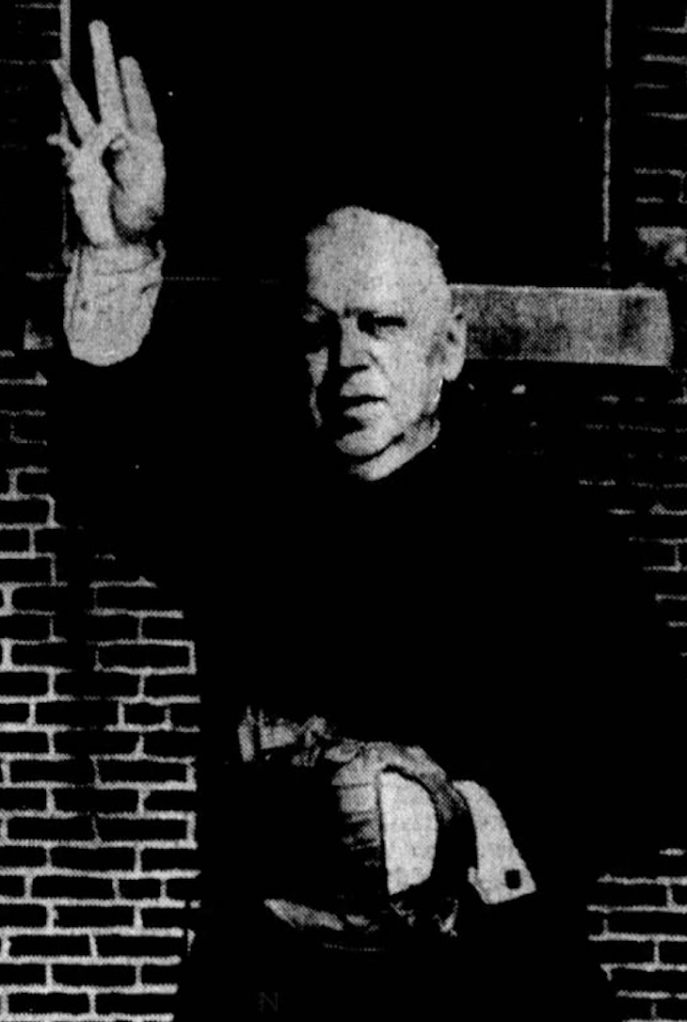
ALLAN TRAVERS – After graduating from St. Joseph’s College in 1913, Allan Travers entered the Society of Jesus and was ordained a priest in 1926, becoming the only priest ever to play in a Major League game. He rarely spoke about his brief time pitching in the Majors, finally breaking his silence in a 1955 interview with sportswriter Red Smith. Father Travers died in Philadelphia on April 19, 1968.

DANIEL MCGARVEY – After holding down left field for the replacement Tigers and later serving in the United States Navy during World War I, McGarvey returned home and worked as a civilian machinist at the Philadelphia Navy Yard. From 1927 until 1945, he was periodically admitted to veterans’ institutions that cared for disabled and mentally ill veterans. He died on August 18, 1945, in Kecoughtan, Virginia. His wife, Nan Bell Wigmore McGarvey, is buried beside him at Greenlawn Memorial Park in Newport News, Virginia.
JOSEPH “HAP” WARD – Continuing his work as a salesman after the replacement game, Ward kept a low profile. He later claimed exemption from the WWI draft due to being the sole provider of his mother and wife. In June of 1918, however, he travelled to France and Italy as a YMCA staff member. YMCA staff and volunteers provided 90% of welfare work during WWI.
Ward passed in Elmer, New Jersey on September 13, 1979. His leaping catch robbery of Jack Barry in the replacement game remained one of his proudest achievements.

JOHN COFFEY (AKA JACK SMITH) – Two months after playing solid defense for the Detroit Tigers at third, the young misfit Coffey was arrested and fined for shouting on the Philly streets that President Roosevelt had been assassinated. He spun the lie in order to sell newspapers. When later arrested for the crime, Coffey claimed that another unruly youth had given his name to those buying newspapers, and that he actually hadn’t been the individual responsible at all. Mrs. Martin K. Coffey—his mother—even backed her son’s claim of innocence. An investigation revealed that it was in fact Coffey who’d shouted that Roosevelt was no more.
After a period of rebellion, which included additional time spent in county jail during WWI, Coffey cleaned up his act and moved to New York, working as a writer for a publishing company (honing in on a clear knack for fibbing). He died in NYC on December 4, 1962.
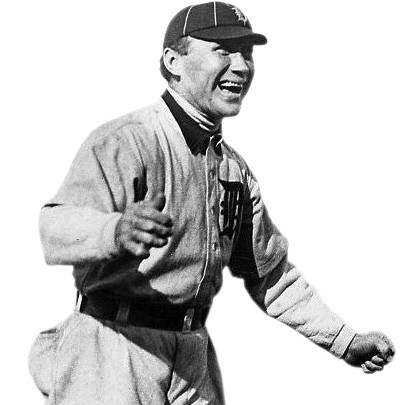
HUGHIE JENNINGS – The eccentric and fiery manager would coach the Tigers until 1921, riding the success of three consecutive pennants obtained earlier from 1907 to 1909 (with additional job security given his popularity and success as a player for the Baltimore Orioles dynasty of the mid 1890s).
During the offseason as a manager, Jennings attended Cornell Law School and later practiced law. After coaching the New York Giants from 1921 to 1925, Jennings retired to Scranton, Pennsylvania, where he died in 1928. Bolstered by a career .312 batting average, 1,526 hits, and 359 stolen bags, he was elected to the Baseball Hall of Fame as a player in 1945.
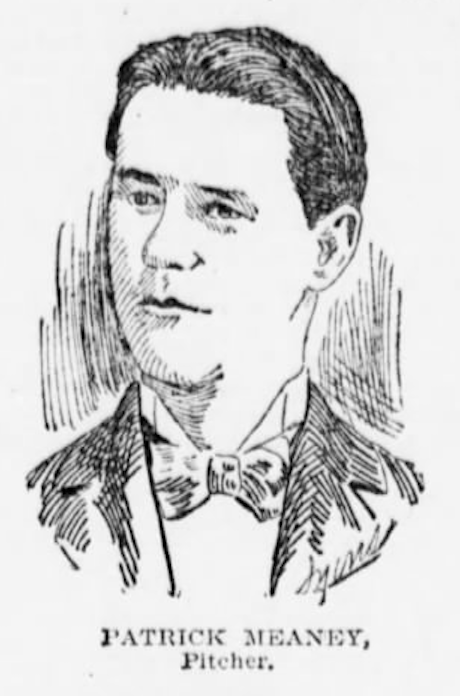
PATRICK MEANEY – The replacement game was likely the last professional baseball game Patrick Meaney ever played (if his identity was not Vincent Edward Maney). At 40 years old in 1912, “Pat” Meaney’s well-documented minor league career had come to an end in 1909. He was later known as a sandlot player. A decade after the replacement game, he developed a brain tumor of which he passed away on October 20, 1922 in Philadelphia. At the time of his death, his occupation was recorded as “ballplayer”.

DEACON MCGUIRE – McGuire’s remarkable major league career spanned 28 seasons, from his debut with Toledo in 1884 to his final appearance in the Tigers’ 1912 strike game (which was his last game ever). One of baseball’s most durable catchers, he spent 26 seasons behind the plate and later managed the Washington Senators, Boston Red Sox, and Cleveland Naps. In 1912, he joined Hughie Jennings’ Tigers as a coach and scout. McGuire retired to his farm near Deer Lake, Michigan, where he died of bronchopneumonia on Halloween of 1936.

JOE SUGDEN – Although well past his playing prime in 1912, Joe Sugden remained in baseball shape and had also filled in at first base during the Tigers’ 1912 Spring Training tour. That Spring, tragedy struck when his wife, Agnes, died suddenly in Philadelphia before Sugden could return home to be with her. During World War I, he applied for a passport to travel to France with the YMCA to assist the American Expeditionary Force. Sugden remained in professional baseball as a scout and coach for the Tigers, Cardinals, and Phillies until his death in Philadelphia on June 26, 1959.
BILL LEINHAUSER – After his one day baseball career, Bill Leinhauser joined the Philadelphia Police Department in 1917, eventually rising to Lieutenant in charge of the Narcotics Bureau. He also served three years in the Pennsylvania National Guard before serving in France during World War I. In 1953, Police Commissioner Joseph S. Clark briefly suspended Leinhauser for alleged negligence, but a police trial board later cleared him of all charges.
Leinhauser retired from the Philadelphia Police Department in 1959. During the mid-1950s, Leinhauser assisted S.C. Thompson, co-author of The Official Encyclopedia of Baseball, in identifying the full names and birth information of the Detroit Tigers’ replacement squad. He died on April 14, 1978, in Elkins Park, Pennsylvania.
JIM MCGARR – Five years removed from his appearance for the replacement Tigers, McGarr found himself serving as a Philadelphia firefighter. He also served in the United States Army during WWI, where he was treated for shrapnel wounds and shell shock from combat. He returned home and continued his firefighting career before opting for a surprising career change: he left the Fire Department and opened a café.
In 1947, he relocated from Philadelphia to Fort Lauderdale, Florida. At 92-years-old, as the last surviving member of the replacement Tigers, McGarr passed away in Florida on July 21, 1981 at the Veteran’s Hospital in Miami.

Dylan James is the author of a dozen plus short story, novel, and poetry publications, appearing in Horror Tree’s Trembling With Fear, Moria Literary Magazine, and more. His sci-fi horror novel Cedar Mills (Savage Realms Press) was published in 2025.
A lifelong passion for baseball instilled by his dad (mixed with a love for history) led to this article being researched, created, and shared.

